
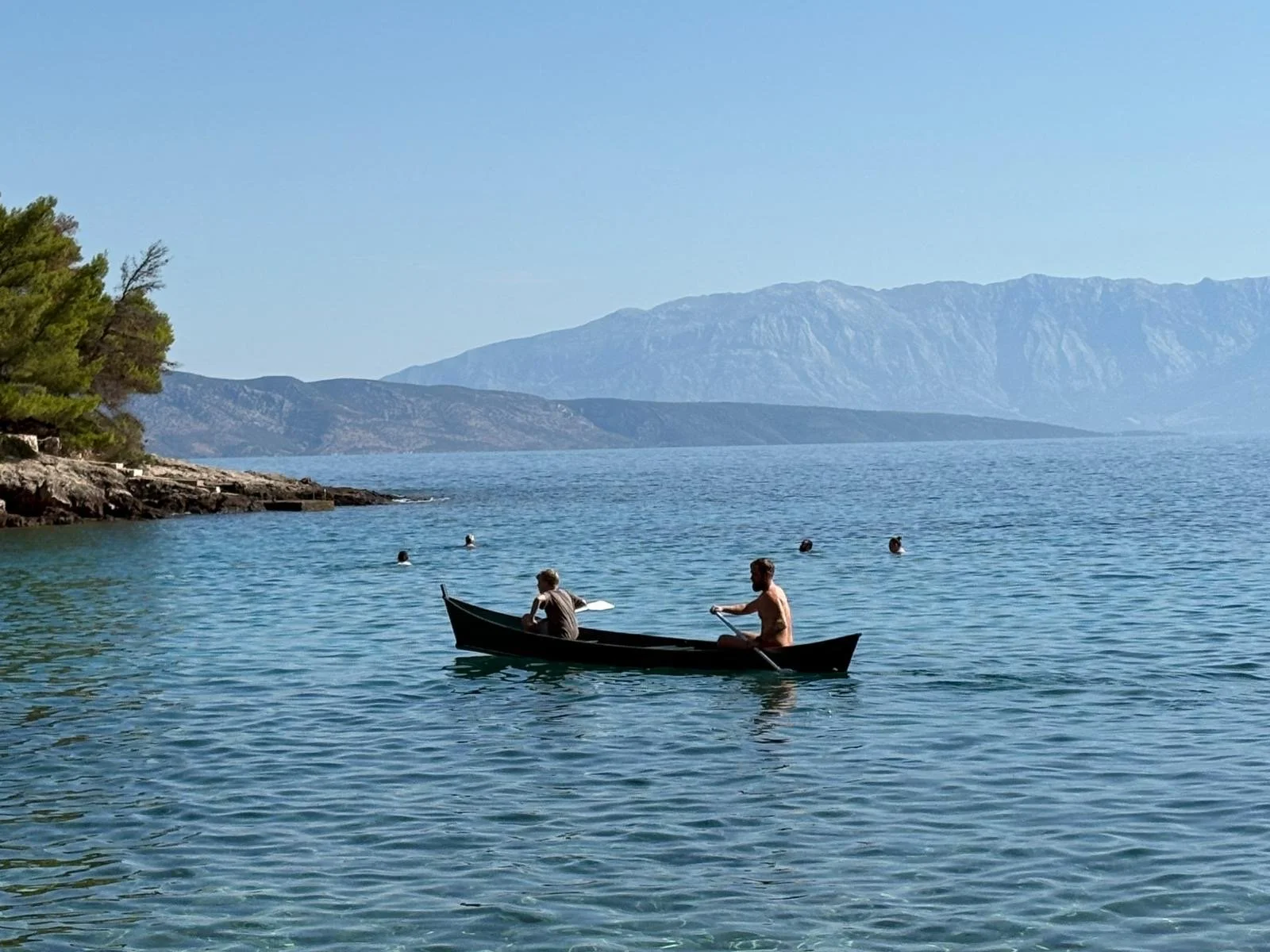
Croatia’s Digital Nomad Permit
How We Did It. A step-by-step guide from an American family

This is one family's experience as of October 2026, not legal or tax advice. Croatia’s MUP is the authority. Check with them before you rely on anything below.
Ashley and her family joined The Field School of Hvar in June of 2026. They fell in love with the island and the program, and decided to return for the 3-month fall term. As Americans, this return visit would put them over the maximum number of days that non-EU citizens can visit the Schengen area, which includes most European countries. When Ashley returned to the US in July, she went to work on obtaining one of Croatia’s digital nomad “visas” - actually a residence permit - which entitles the holder to stay in Croatia for up to 18 months.
The application for residence is straightforward, but requires planning. This document is her “cheat sheet” for understanding the process and possible snags along the way.
The steps at a glance
Part 1: Before you leave the US
Check that you qualify
Order your FBI background check
Get your documents apostilled
Buy health insurance
Gather your documents
Part 2: Once you arrive in Croatia
Arrive and register your address
Get your documents translated
Get passport photos
File your application
Pay fees and finish up after approval
File for your kids (family reunification)
Before you start
Online vs. In-Person. You can file the digital nomad permit online or do the whole thing in person. Kids can't file online. They apply in person for family reunification, and their application is attached to the primary applicant's.
Start early, but not too early. Apostilled documents are only good for 6 months in our experience. I collected all the documents I needed in July and August for a September departure date.
Plan your time away. You can't leave Croatia for more than 30 days in a row without losing the visa. So this isn't a full-year option unless you're moving here. A permit longer than a year allows 60 days away at once. See Time away from Croatia below.
Save some Schengen days. There's a 6-month wait from your last visa before you can apply again.
File early. I submitted my form online, then our dependents applied in person. Next time I think I'd submit it a good two months ahead of our departure, though I'm not sure there's really a difference.
Cost
For a family of 3 living in South Carolina:
About $1,200 for translations and to get everything apostilled: three birth certificates, our marriage certificate and 2 FBI background checks.
Visa fees, but only if you're approved. See Step 10.
Part 1: Before you leave the US
1. Check that you qualify
Checked against MUP's English pages on October 23, 2026. The income figure changes every year, so check it again before you file.
Who qualifies: A non EU, EEA or Swiss citizen who works remotely for a company, or their own company, that is not registered in Croatia
Visa-required nationals: Must apply at a Croatian embassy or consulate. MUP rejects their applications at a police station
Income: At least 2.5 average Croatian monthly net salaries for the previous year. MUP shows EUR 3,622.50 a month right now
Lump sum instead: EUR 43,470 for 12 months, or EUR 65,205 for 18 months
Family members: Each one adds 10% of the average monthly net salary, about EUR 144.90 at today's figure
How long: Up to 18 months. MUP says "up to a maximum of eighteen months (possibly even less)"
Extension: Only if you were granted less than 18 months. Apply no later than 60 days before it ends. MUP grants up to 6 more months
Applying again: You can file a new digital nomad application 6 months after your last stay ends
Croatian income tax: The Income Tax Act says income earned for an employer not registered in Croatia, under digital nomad status, is not taxed as income (Article 9). This covers Croatian tax only.

Step 2. Order your FBI background check
We ordered the FBI Identity History Summary direct from the FBI at edo.cjis.gov, with fingerprints at a US post office.
Ask for the mailed hard copy. A PDF can't be apostilled.
Step 3. Get your documents apostilled
We got the FBI report apostilled through Monument Visa Services.
We also apostilled three birth certificates and our marriage certificate.
Step 4. Buy health insurance
You need health insurance that covers Croatia for your whole stay. Regular travel insurance won't work. It caps at around 45 days, so you need a longer-term policy.
We used WorldTrips Atlas Travel, bought through Squaremouth. It comes with a visa letter you can file with the application.
Step 5. Gather your documents
Passport valid at least three months past the end of your stay
Proof of purpose: your own statement, plus a contract with a foreign employer or client, or registration of your own non-Croatian company
Proof of income: a bank statement showing the total, a bank statement showing regular income, or six months of payslips. I printed my bank statements and highlighted the income
FBI criminal record check from your home country, or from any country you lived in for more than a year right before Croatia, legalised. We used an apostille. Not needed for an extension
A Croatian address. A hotel or hostel booking works for a first application
Everything must be in Croatian or English, with an authorized translation for anything else. State the currency on every money document. Online uploads are PDFs, 2 MB at most.
Part 2: Once you arrive in Croatia
Step 1. Arrive and register your address
Register your address within 3 days of arriving in Croatia. Our landlord did this for us, as required by law. (Don't try to lease under the table.)
Mail reached our Jelsa address with no problem. I asked our landlord first, then addressed it to her with "za [your name]".
Step 2. Get your documents translated
Our translator was Dragana Mihanović, a sworn court interpreter near Split (sudskitumacmihanovic.hr). We recommend Dragana.
Digital copies came the same day we asked, and the originals came quickly to Jelsa by post.
Step 3. Get passport photos
You need 30x35mm photos. There's an instant passport photo place in Hvar Town, about a 15-minute walk from the bus station.
Step 4. File your application
Online: use the MUP digital nomad application. It goes to the police administration for your address. You get an automatic receipt, then a caseworker who may ask for more documents. MUP's page doesn't say whether you can stay while you wait. Kids can't file online.
In person: at a Croatian embassy or consulate, or the police administration or station for your Croatian address. You hand in the packet at the counter. MUP says a visa-exempt applicant "may remain in the Republic of Croatia until the decision on the application becomes enforceable." Kids must file in person.
Our packet: passport, 30x35mm photos, Form 1a, business registration and client contracts, bank statements, health insurance, and the Jelsa lease.
We filed our application online on August 26, 2026. Eight weeks in, we've had no update or decision.
Filing in person at the Hvar Town police station
The police station is very close to the bus station.
Take the early bus from Jelsa. Don't go later in the day.
Only 2 people are allowed in at a time. Expect to wait outside: bring water, a snack, and something to keep you busy while standing.

Part 3: After you file
Step 1. Pay fees and finish up after approval
Next comes caseworker review. After approval you pay the fees, register your temporary residence, and pick up the biometric card in person. You don't need an OIB until you're approved.
Register within 30 days of the date your stay starts. MUP revokes the stay if you miss it.
Fees at a police administration or station: EUR 46.45 temporary stay, EUR 9.29 administrative fee, EUR 31.85 biometric card (EUR 59.73 accelerated). EUR 87.59 total at the standard card price
Fees at an embassy or consulate: EUR 55.74 temporary stay, plus EUR 93.00 for a D visa or EUR 41.14 for the biometric card
Step 2. File for your kids (family reunification)
File only after the parent is approved. MUP says family applications "submitted before the third country national with whom family reunification is requested in the Republic of Croatia has been granted temporary stay for the purpose of stay of digital nomads shall be rejected."
The child applies in person at the police station, for photo and fingerprints.
The child's application is attached to the primary applicant's.
Bring the apostilled birth certificate and the other parent's consent. If the other parent can't come to the counter, MUP says "the consent may be given in a form of a written statement certified by a notary public."
While you wait
If your application is denied, you can ask the police station for a letter confirming you were in the country legally. Ask how your Schengen days are counted before you travel.
Time away from Croatia: under MUP's general rules, a permit of up to one year allows 30 days away at once or 90 in total. Up to 18 months, it's 60 at once or 180 in total. One absence of up to 90 days for a justified reason is fine if you tell the police beforehand. MUP's digital nomad page has no absence rules of its own, so ask your police station.
Links and contacts
Online application: digitalnomadscroatia.mup.hr
MUP digital nomad rules: Temporary stay of digital nomads
MUP family reunification rules: Family reunification
MUP rules for minor children: Minor children
FBI background check: edo.cjis.gov
FBI apostille: Monument Visa Services
Translator: Dragana Mihanović, sudskitumacmihanovic.hr
MUP questions: pitanja@mup.hr